
I’m pretty sure you don’t give a crap about chemistry, so I’m not going to explain what PFAS stand for. Instead I’m going to try to explain about different types. Hopefully in a way that doesn’t make you want to take a nap. We’ll start with ladders.
Ladder PFAS
You can think about PFAS like a family of different types of ladders and ladder-like objects. The PFAS you’ve heard most about unfortunately has very similar sounding acronym, PFOS. You may also have heard about PFOA, which has the highest know toxicity. Both of these are eight-rung ladders, meaning that they have eight C’s that are all surrounded by F’s. You’ll also hear these called “C8” or “eight-carbon” PFAS.
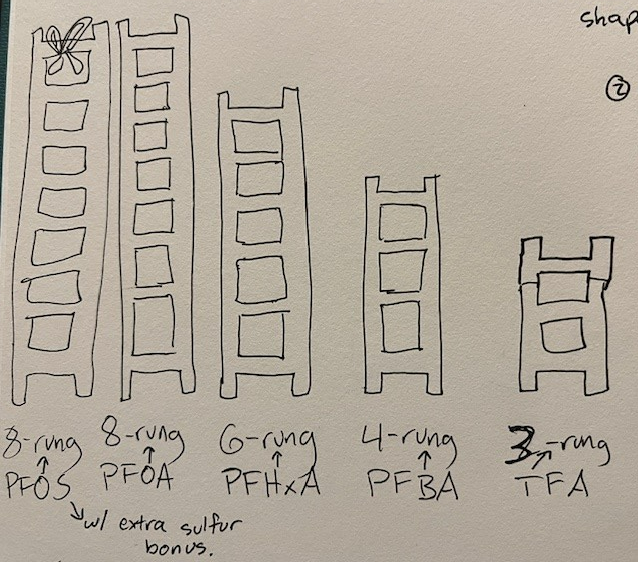
Since these eight-rung PFAS were the first to be widely used and studied, we know quite a bit about them, including the fact that they can be pretty toxic to people and animals. The United States called on companies to stop using PFOS and PFOA, which were phased out of use 2002 and 2015, respectively1. (They are still made and used in other countries, though). In response, many manufacturers switched to C6, or six-rung PFAS ladders. These six-rung versions had many of the benefits of the eight-rung ones, but were less scrutinized at the time. We now know that six-rung PFAS are equally persistent, more mobile, and also have health risks. Four-rung PFAS are commonly used now. These are nearly ubiquitous in drinking water sources, and are really difficult to remove from water. Like, removing PFOS from drinking water is expensive, but removing the 4-rung version is 3-5 times more expensive on an annual basis.
So straight-chain, ladder PFAS are a problem.
Well, this isn’t a ladder. . .
In addition, a whole extended family of ladder-like PFAS have sprung up. Have you seen those ninja course play-things around your neighborhood? Imagine someone decided long ladders were unsafe for children, so banned eight-rung ladders. Those ladder makers then went around making six-chain ladders. And when those ladders were banned or criticized, they make these Frankensteiny combinations of climbing contraptions that look like ladders, but have a lot of other add-ons and features. This is like the universe of other PFAS outside of PFAAs. It includes other things that look like ladders, ladders connected to other lots of other ladders, and ladders connected to things that aren’t ladders. Sheep the the grass shit.
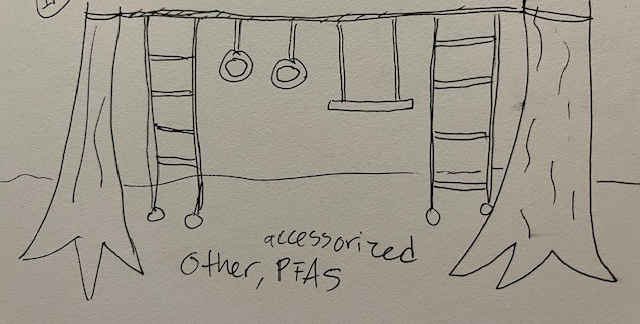
The original class of PFAS used and studied was the simple, ladder PFAAs, like PFOA and PFOS. But today, those only account for about 0.1% of PFAS emissions to the environment. “F-gasses” account for about half and “fluoropolymers” account for around ten percent2. So many F words. Many F-gasses degrade to two-rung TFA, which is building up in the environment and likely in people too.
Making ladders by accident
One problem with the different types of PFAS ninja courses is that once they are in the environment, many of them degrade into ladder PFAS over time. Imagine you throw away a ninja course set into a trash heap. Maybe some of it breaks up into bits, and you could imaging pulling out something looking like a ladder in a few decades. Same type of thing with PFAS. So just because PFOA and PFOS aren’t actively being made by companies in the US anymore, doesn’t mean that they aren’t being produced as a by-product of other things. The types of things that can turn ninja course PFAS into ladder PFAS are things like sunlight, oxygen, and water2. Things that are pretty common out there in the world.
So what? There are so many types of PFAS, what the hell can we do about it? Well, ideally we regulate them as a class and try to stop using them as much as possible.
Want the sciency shit?
[1] U.S. EPA. (2017). Technical Fact Sheet—Perfluorooctane sulfonate (PFOS) and perfluorooctanoic acid (PFOA) (EPA 505-F-17-001). Elsevier. https://doi.org/10.1016/B978-0-12-382032-7.10047-5
[2] Evich, M. G., Davis, M. J. B., McCord, J. P., Acrey, B., Awkerman, J. A., Knappe, D. R. U., Lindstrom, A. B., Speth, T. F., Tebes-Stevens, C., Strynar, M. J., Wang, Z., Weber, E. J., Henderson, W. M., & Washington, J. W. (2022). Per- and polyfluoroalkyl substances in the environment. Science, 375(6580), eabg9065. https://doi.org/10.1126/science.abg9065
 PFASt and loose - an illustrated primer for normal people
Leave a comment